The payment method gap is costing merchants billions.
In markets across Africa, Southeast Asia, Latin America, and the Middle East, credit card penetration remains low, often below 20%. But digital payment adoption is exploding. Mobile wallets, bank transfers, BNPL services, and mobile money platforms are how people actually pay.
A customer in Kenya reaches your checkout page with money ready to spend. But you only take Visa or Mastercard. They use M-Pesa. Sale lost. A shopper in Brazil wants to pay with Pix but you don't support it. They close the tab and buy from a competitor who does.
Here's the thing: if you don't offer payment alternatives, your business becomes nothing but an alternative to customers, one they'll most likely skip.
Alternative payment methods (APMs) give customers more ways to pay and that directly impacts your conversion rates. This guide shows you what they are, why they matter, and how to implement them without the technical headaches.
What Are Alternative Payment Methods?
Alternative payment methods are any payment option beyond traditional credit and debit cards. They include:
Digital wallets like Apple Pay, Google Pay, and Samsung Pay
Buy now, pay later services like Tabby, Tamara, and Klarna
Mobile money platforms like M-Pesa and MTN Mobile Money
Bank transfers and direct debit options through open banking
Cash-based payments like Fawry in Egypt or OXXO in Mexico
Local payment schemes like Mada in Saudi Arabia or Meeza in Egypt
Globally, there are more than 200 alternative payment methods available. The shift toward APMs is driven by mobile commerce, where entering card details is inconvenient, and by regional preferences where cards simply aren't the default.
How to Boost Conversion Rates with APMs
You can boost conversion rates with APMs by offering the payment methods your customers actually use, making checkout faster and more familiar, and reducing payment failures from cross-border card restrictions.
Here's why this works and how to implement it:
Match Customer Payment Preferences
Most consumers have one or two preferred payment methods. Offering anything else is useless to them. If their preferred method isn't available, they'll abandon the purchase or shop elsewhere.
Research shows that offering the top three payment methods in a market, rather than just the most popular one, can increase conversions by up to 30%. The math is simple - more relevant options mean more completed purchases.
Optimize for Mobile Commerce
Entering 16-digit card numbers repeatedly is frustrating. Digital wallets and saved payment methods process in seconds with biometric authentication. The faster someone can pay, the more likely they'll complete the transaction.
Many APMs are mobile-first by design. Implementing them properly means your checkout works flawlessly on phones with wallet integrations that launch smoothly and payment flows that don't require excessive typing.
Build Trust Through Familiarity
People trust what they know. Someone who's used M-Pesa for years will feel more comfortable paying with it than entering card details on an unfamiliar website. In many markets, offering local payment methods signals legitimacy and builds shopper confidence. This trust factor is especially important in emerging markets where consumers may be cautious about sharing financial information with new merchants.
Reduce Payment Failures
Cross-border card transactions fail for multiple reasons - issuer restrictions, fraud prevention, currency issues. Local payment methods bypass these problems because they're designed to work seamlessly in that specific market.
When you route a transaction through a payment method that's native to the customer's region, you eliminate many of the technical barriers that cause declines.
Implement the Right Mix
Based on your market research, offer at least the top three payment methods for each region you serve. This covers most customer preferences without creating checkout clutter. For example:
KSA merchants should support Mada cards, Apple Pay, and a BNPL option like Tamara
Nigerian merchants need bank transfers, card payments, and mobile money options
Indonesian merchants should offer local wallets (GoPay, OVO), bank transfers, and cards
Brazilian merchants must support Pix, cards, and potentially installment payment options
Display Options Clearly
Show supported payment methods early on product pages and at cart view. Don't make customers enter shipping information before discovering you don't accept their preferred method. That's a guaranteed way to lose the sale.
Use recognizable payment icons. Visual cues build trust. When customers see familiar logos, they know they can complete the purchase.
Localize the Full Experience
Display prices in local currency. If someone chooses M-Pesa, give them clear steps in a format they recognize. These small details reduce confusion and increase completion rates also enabling you expand global reach with region-specific options.
Monitor and Adjust Continuously
Track conversion rates by payment method. Analyze which options customers actually use versus which sit idle. Payment preferences shift over time, so what worked six months ago might not be optimal today.
Merchants must continually analyze the conversion rate and usage of each payment method and be ready to adjust when needed. Work with a payment provider that gives you comprehensive analytics to make informed decisions about your payment mix.
Regional Payment Preferences: Where APMs Matter Most
Different markets have different payment landscapes. Here's what matters in key regions:
Middle East and North Africa
APM adoption in MENA is significant. 85% of consumers in the region used at least one emerging payment method in 2022.
Cash on delivery remains popular, but digital adoption is accelerating with contactless payments having reached 94% penetration in Saudi Arabia and 84% in the UAE at the point of sale.
Digital wallets are also growing fast. 46% of the UAE population used mobile wallets like Apple Pay, Google Pay, and Payit for daily purchases as of 2024. In Saudi Arabia, local wallet STC Pay has attracted over 15 million users by 2024.
BNPL services are booming. More than 50% of consumers in the Middle East, North Africa, and Pakistan used BNPL in 2022. Major providers like Tabby and Tamara each boast around 10 million users across Saudi Arabia, Kuwait, UAE, and Bahrain.
Sub-Saharan Africa
Mobile money is king. M-Pesa processes billions of transactions in Kenya and neighboring countries. MTN Mobile Money operates across multiple markets. Airtel Money has significant reach. Card penetration remains low, making mobile-first payment options essential rather than optional.
Southeast Asia
Each country has its own dominant methods. GrabPay and GCash work in the Philippines. GoPay and OVO are major players in Indonesia. PromptPay enables instant bank transfers in Thailand. Touch 'n Go eWallet serves Malaysia. Supporting local wallets is critical for market entry.
Latin America
Pix transformed Brazilian payments practically overnight. OXXO cash payments dominate Mexico. Mercado Pago operates as a regional wallet across multiple countries. Local bank transfers and installment payments are common throughout the region.
Understanding these preferences helps you prioritize which APMs to implement first when entering or expanding in these markets.
How to Identify the Right APMs for Your Market
Before adding payment methods randomly, you need to understand what your customers actually use. Here's how to figure that out:
Analyze Your Customer Base
Start with your data. Where does your traffic come from? Which countries generate the most cart abandonments? Look at checkout analytics to see where people drop off. High abandonment at the payment step signals a mismatch between what you offer and what customers want.
Understanding end-user device preferences is crucial too. Mobile shoppers behave differently than desktop users. If most of your traffic comes from mobile devices, prioritize methods that work seamlessly on phones - digital wallets, saved payment options, and mobile money.
Research Local Payment Preferences
Every market has dominant payment methods. Look at the regional breakdown above as a starting point. Industry reports from payment providers often detail market preferences by country. Use these to inform your strategy, but validate against your own customer behavior.
Study Your Competitors
Look at what payment methods successful competitors in your market accept. If three major players all support Tabby in the UAE, there's a reason. They've done the research and seen the results.
Check competitor checkout pages directly. Note which methods they feature prominently. Pay attention to local players—they often understand regional preferences better than international brands trying to enter the market.
Survey Your Customers
When in doubt, ask. Simple post-purchase surveys or exit intent pop-ups can reveal what payment methods customers want. People will tell you if you give them the chance.
Work with an Experienced Payment Provider
The research, integration, and optimization work described above takes time and resources. But there's a faster path forward. Working with a payment orchestration platform like MoneyHash removes the guessing game entirely. With access to 300+ connections across 40+ markets and 150+ payment methods through a single integration, you can test different payment mixes without building each integration from scratch.
This approach gives you market flexibility to experiment with new payment methods quickly. Launch in a new country? Activate the relevant APMs and start processing payments immediately. See competitor offering a payment method you don't have? Add it without engineering sprints.
The result? Faster go-to-market, reduced chances of integration errors, better testing capabilities, and optimized revenue through the right payment mix for each market.
How MoneyHash Simplifies APM Integration
You've identified which APMs your customers want. Now comes the hard part - actually implementing them across multiple markets without the technical nightmare of managing dozens of provider integrations.
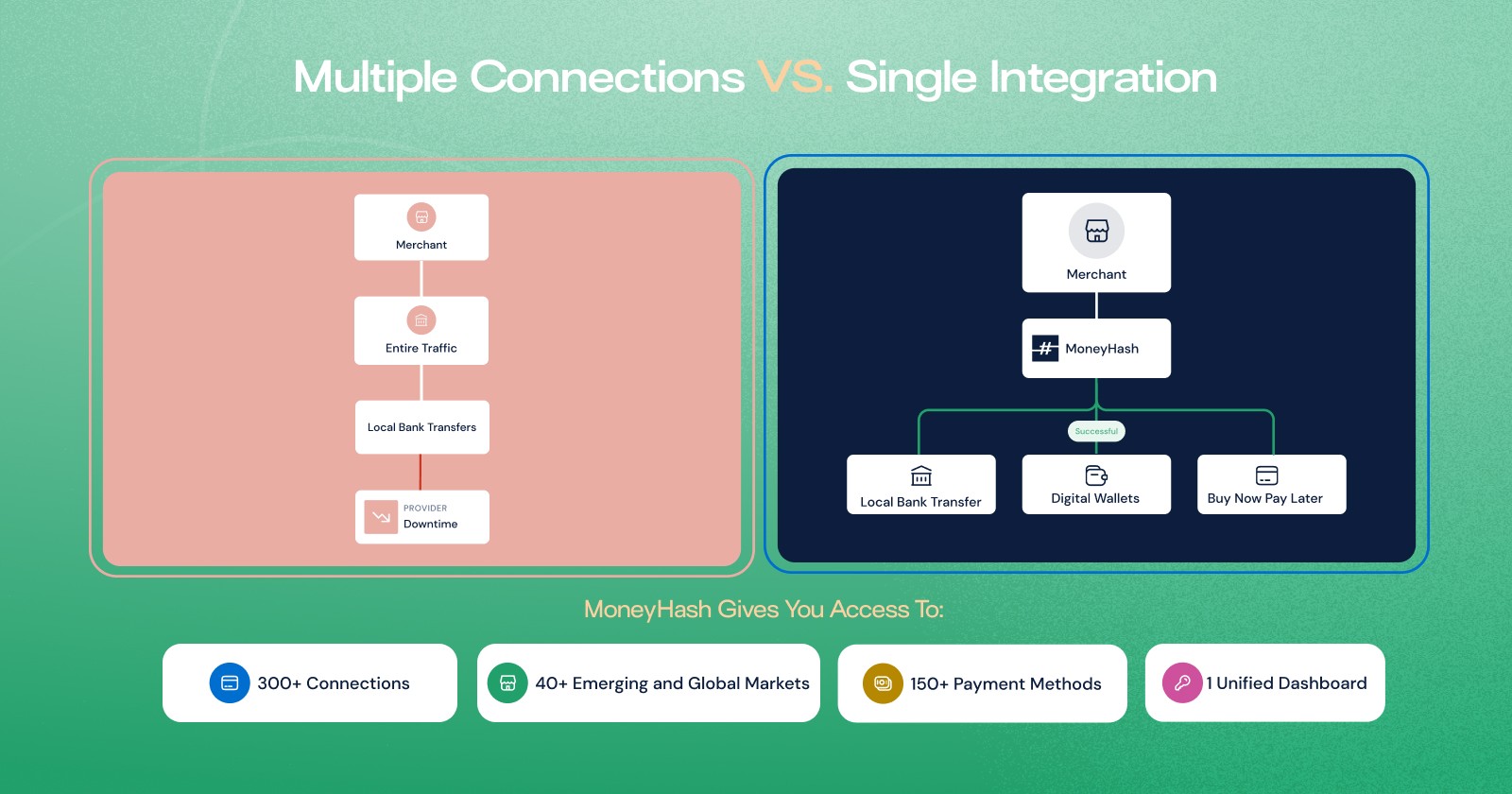
Launch Faster, Test Smarter Most merchants spend months negotiating with payment providers and building separate integrations for each method. One integration with MoneyHash replaces all of that. Get immediate access to payment methods across 40+ markets without separate technical builds.
Test in real time. Add Apple Pay in the UAE and measure conversion lift within days. Launch BNPL in Saudi Arabia and see the impact on order value immediately.
Reduce Risk, Increase Reliability
Every integration you build is a potential point of failure. Different APIs, authentication methods, and error handling across dozens of providers drains engineering resources and introduces bugs. One universal API eliminates these risks. Provider updates don't break your checkout. Security compliance is handled. Your team focuses on your business, not payment infrastructure.
Maximize Revenue Through Dynamic Routing
Different providers have different success rates for different transaction types. A provider that excels with Saudi cards might underperform with Egyptian ones. Configure routing rules based on card type, geography, transaction amount, and payment method. Send each transaction to the provider most likely to approve it. This optimization lifts authorization rates automatically.
Scale Across Markets Without Starting Over
Entering a new market shouldn't require rebuilding your payment stack. With MoneyHash, activating payment methods for a new market is straightforward. No new negotiations. No additional integrations. Just enable what you need and start processing.
Choose Your Integration Approach
Different businesses have different technical requirements. Some need full control over the checkout experience. Others want the fastest path to accepting payments. MoneyHash supports:
Hosted checkout gets you live in days with minimal development
Embedded web forms balance customization with quick implementation
JavaScript SDK gives you control over the user experience
Server-to-server for complete flexibility
Mobile SDKs for Android, iOS, Flutter, and React Native apps
Moving Forward with APMs
Alternative payment methods aren't optional in emerging markets. They're the baseline.
Start by identifying which payment methods your customers actually use. Implement the top three for each market. Monitor conversion rates by payment type. Adjust based on real data, not guesswork.
The payoff? More completed purchases, higher conversion rates, and revenue that was walking away at checkout. Emerging markets have unique payment landscapes. MoneyHash specializes in emerging and global markets - where APMs matter most and where traditional payment infrastructure often falls short.
Ready to see how MoneyHash can transform your payment infrastructure? Schedule a free experience call to see the power of our platform firsthand - 300+ connections, 150+ payment methods, 40+ markets, one integration. Let's show you what's possible.


Author:

Eseosa Osayimwen
Content Manager